

Before You React, Be Still
Before You React, Be Still
There is a small space between what happens and what you do next. Learning to meet Jesus there can change the way you respond.
“Be still, and know that I am God.”
Psalm 46:10Sometimes the hardest moments are not the big ones.
They are the few seconds after someone says something that hurts. The moment an anxious thought enters your mind. The instant something doesn’t go according to plan.
The text you weren’t expecting.
The answer you didn’t want.
The silence that feels uncomfortable.
The fear that suddenly begins telling you what might happen next.
And almost immediately, something inside us wants to respond.
Fix it.
Defend yourself.
Send the message.
Replay the conversation.
Assume the worst.
Try to control what happens next.
Not because the situation doesn’t matter. Not because you need to pretend you aren’t afraid, disappointed, frustrated, or hurt.
But because sometimes the most faithful response begins by creating a little space between what happened and what you do next.
The space between the thought and the response
Being still doesn’t mean doing nothing forever.
Sometimes stillness lasts only a few seconds.
It is the moment when we stop allowing fear, anxiety, anger, or uncertainty to make the next decision for us.
We become present.
We notice what is happening inside us.
And instead of immediately following the thought wherever it wants to take us, we bring it into the presence of Jesus.
This is where the STILL Method begins
We created the STILL Method as a simple, Scripture-centered rhythm for moments exactly like these.
Stop and Become Present
Before trying to solve the thought, stop. Take a breath. Notice what is happening inside you without judging yourself for it.
You don’t have to fix everything in this moment. Just become present with God.
Take the Thought Captive
Ask yourself: What am I actually telling myself right now?
Maybe it is: This is going to fall apart. They must be upset with me. I’m going to fail. I have to figure this out right now.
Naming the thought helps us see it for what it is—a thought that can be examined rather than a command that must be obeyed.
Invite Jesus In
You don’t have to wrestle with every thought alone.
Jesus, this is what I’m afraid of. This is what I’m believing right now. This is where I need You.
Prayer doesn’t have to be complicated. Sometimes an honest invitation is enough.
Listen for Truth
Now ask a different question: What is true?
Not what fear predicts. Not what anxiety imagines. Not what shame whispers.
What has God actually said?
This is where Scripture gives our minds somewhere solid to return.
Let Go and Trust God
Stillness eventually becomes movement. But now we aren’t moving because fear demanded it.
Maybe the next step is speaking. Maybe it is waiting. Maybe it is forgiving. Maybe it is setting a boundary. Maybe it is refusing to spend the next hour rehearsing something you cannot control.
You don’t have to know the next ten steps. Let God’s truth lead the next one.
Try it with the next thought
The next time you feel yourself reacting quickly, don’t begin by trying to make the feeling disappear.
Simply notice the moment and walk through the rhythm:
- Stop. Become present instead of immediately reacting.
- Take the thought captive. Name what you are telling yourself.
- Invite Jesus in. Bring Him what you are actually thinking and feeling.
- Listen for truth. Return to Scripture instead of automatically believing the loudest thought.
- Let go and trust God. Release what you cannot control and choose the next faithful step.
The situation may not immediately change. The feeling may not immediately disappear.
But something important has happened.
Instead of allowing the thought to lead you automatically, you have created space to respond from the presence and truth of God.
The pause is simple. The practice takes time.
Reading the five steps of the STILL Method is simple.
Living them when your thoughts are racing, your emotions are strong, and you feel pressure to react is different.
You may stop and immediately realize you don’t know how to name what you’re thinking.
You may take a thought captive and wonder whether what you’re believing is actually true.
You may invite Jesus into the moment but struggle to become quiet enough to listen.
You may know a Scripture by heart and still wonder how to apply it to what you’re facing.
And sometimes you may recognize the truth clearly—but still have difficulty releasing the thought you’ve carried for so long.
The goal isn’t to perform five steps perfectly.
The goal is to develop a new rhythm of returning to God—again and again—until stillness becomes a familiar place to begin.
What would change if you practiced this for six weeks?
Imagine not simply knowing the STILL Method, but having practiced it long enough that you begin to recognize the moment your thoughts start pulling you away.
You notice sooner.
You pause before reacting.
You become more familiar with the thoughts that repeatedly trouble you.
You know where to turn in Scripture.
You learn to invite Jesus into places you once tried to manage alone.
And little by little, you begin responding differently.
Not because difficult thoughts never come.
That is the deeper journey behind The STILL Method Workbook.
The STILL Method Workbook
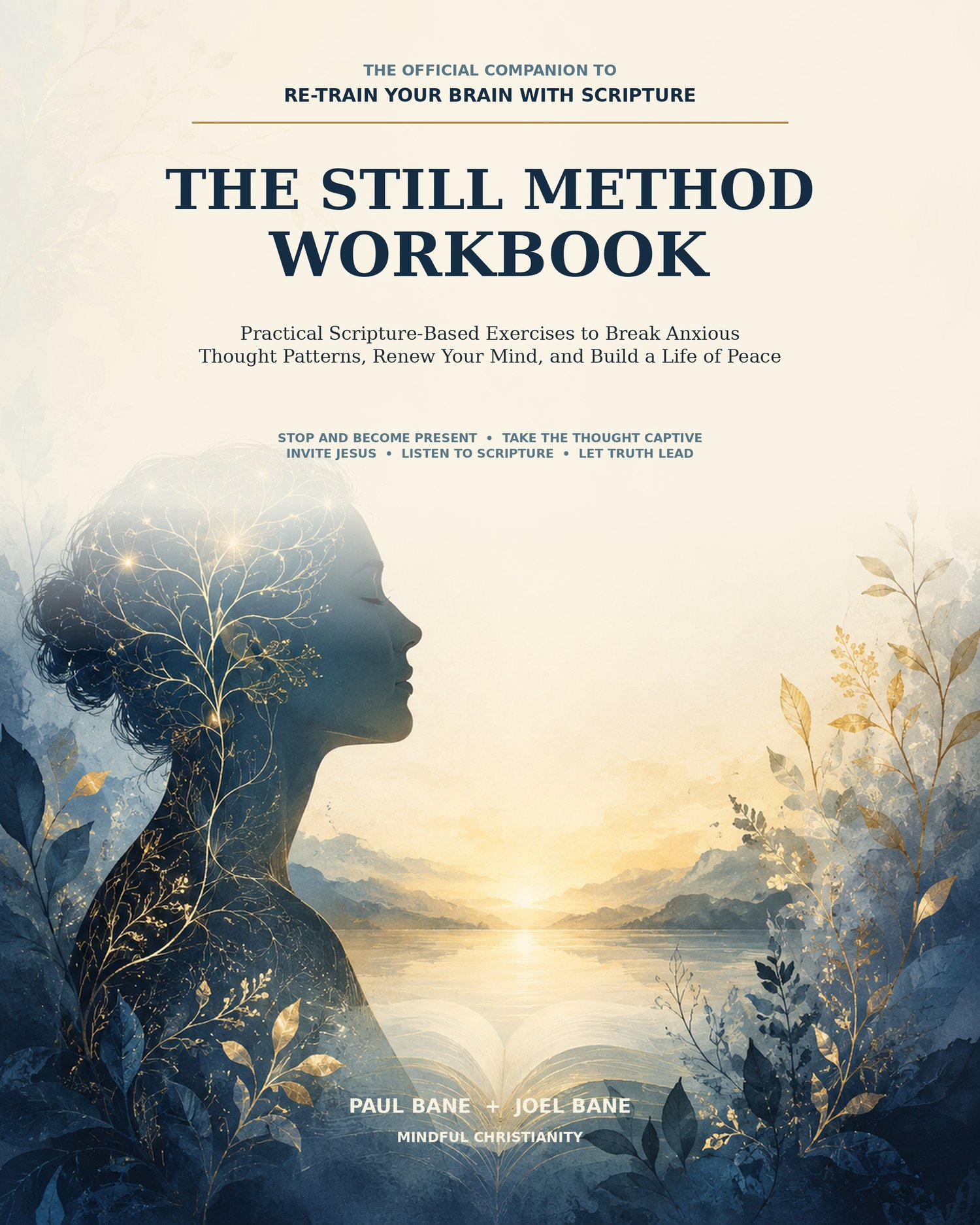
A 6-Week Guided Workbook for Renewing Your Mind With Scripture
Understanding the method is the beginning. The six-week workbook gives you space to actually practice it through Scripture, guided reflection, prayer, thought exercises, and intentional moments of stillness.
Week by week, you’ll learn to recognize recurring thought patterns, bring them honestly into the presence of Jesus, return to the truth of Scripture, and practice a different response.
You don’t have to change every thought today. Start by learning what to do with the next one.
Begin with the next thought
You don’t have to wait until your mind is perfectly quiet to be still with God.
You don’t have to solve everything before you can experience His presence.
And you don’t have to know exactly what comes next.
The next time a thought begins pulling you toward fear, anxiety, frustration, or control, remember:
You can pause.
You can bring the thought into the presence of Jesus.
You can listen again for what is true.
And then you can let His truth lead the next step.
Meet me in the pause.
Jesus, when my thoughts move quickly and my emotions urge me to react, teach me to become still. Help me notice what I am believing and bring it honestly into Your presence. Lead me back to the truth of Your Word. Give me wisdom to release what I cannot control and courage to take the next faithful step. Teach me to return to You again and again. Amen.
Continue Reflecting
Go a little deeper with these reflections on taking thoughts captive and learning to become still with God.

Join the Mission
Help us continue creating and sharing Scripture-centered devotionals, books, music, and resources that invite people around the world into God’s presence.
Join the MissionReceive the Free Weekly Devotional
A quiet moment of Scripture, reflection, and encouragement delivered to your inbox each week.
Join the Weekly Devotional
Grace and peace,
Paul and Joel