
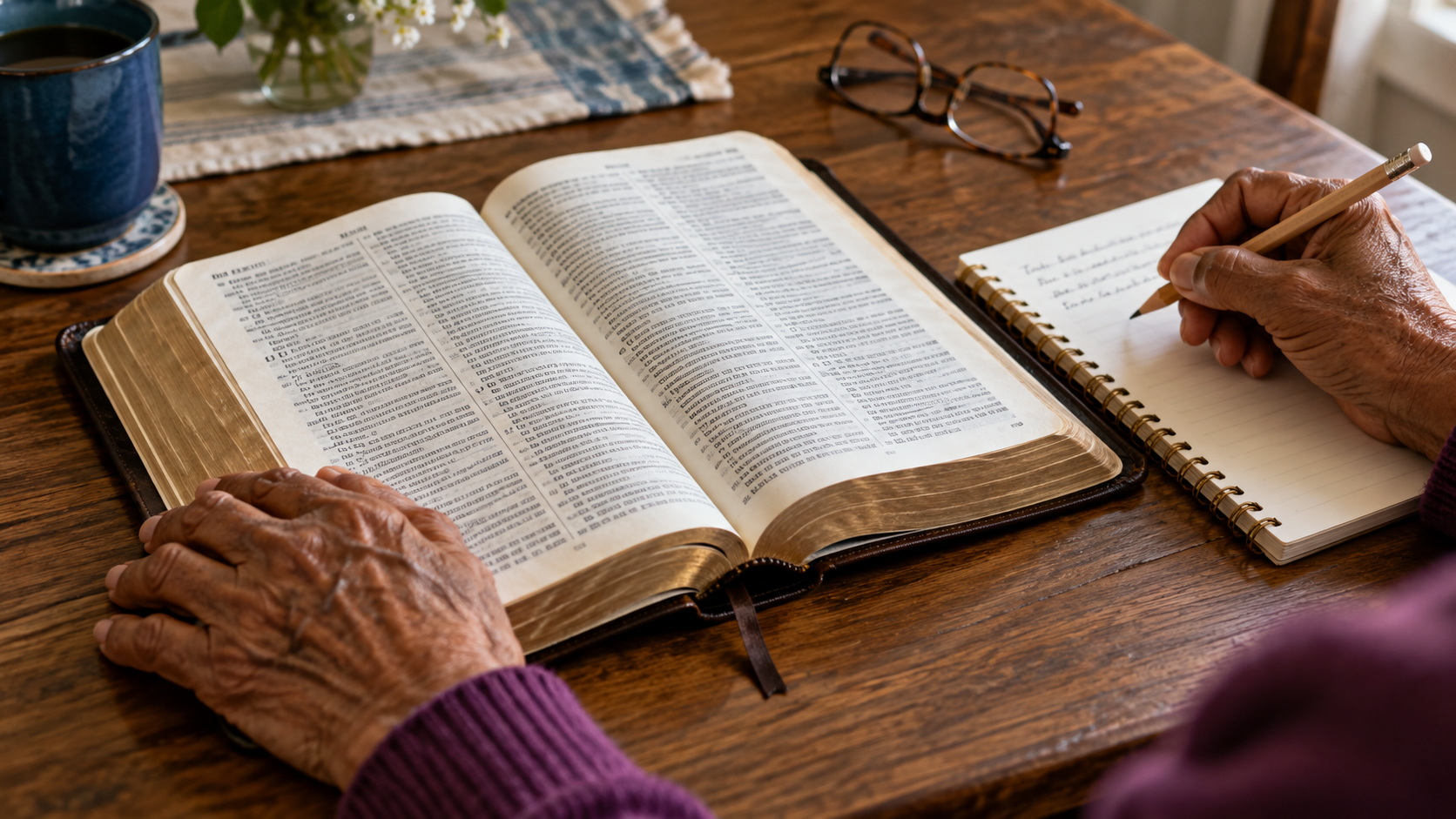
How to Meditate on Scripture: A Simple Christian Practice
How to Meditate on Scripture
A simple Christian practice for reading slowly, praying honestly, and carrying God’s Word into everyday life.
You finish reading a passage, close your Bible, and realize you can barely remember what you read. Your eyes followed the words, but your attention was already moving through the day ahead.
Perhaps you have heard the invitation to meditate on Scripture and wondered what you are supposed to do. Do you repeat a verse? Sit in silence? Wait until something stands out?
Learning how to meditate on Scripture can begin simply: give a short passage your attention, consider its meaning, bring your response to God, and let it shape one part of your day.
You can begin with the time you have and a willingness to listen.
“…whose delight is in the law of the LORD, and who meditates on his law day and night.”
Psalm 1:2 (NIV, excerpt)What is Christian Scripture meditation?
Psalm 1 describes a person who delights in God’s instruction and returns to it throughout life. The image that follows is a tree planted beside water, receiving what sustains its growth.
Meditating on Scripture means lingering thoughtfully with God’s Word. You read with care, consider what the passage means, and allow it to examine your assumptions and guide your response.
This practice belongs alongside Bible study. Understanding the passage helps you reflect faithfully, and reflection gives you time to consider how its truth meets your life.
1. Choose a short passage and read it in context
Begin with a few verses you can read without rushing. Psalm 23, Psalm 121, or a short section of a Gospel can offer a manageable starting point.
Read the surrounding verses, too. Ask who is speaking, whom they are addressing, and what is happening. Notice whether you are reading a prayer, a story, an instruction, or another kind of writing.
Take Psalm 23 as an example. Read the whole psalm before lingering with its opening image of the Lord as shepherd. Notice how the passage holds together provision, guidance, danger, and God’s companionship.
That context helps you receive its comfort without turning it into a promise that life will always feel easy.
2. Read again and consider what the words mean
Read the passage a second time, perhaps aloud. Pause with a phrase that deserves your attention.
Ask: What does this reveal about God? What does it invite me to trust, receive, or do? Is there something I need to understand more clearly?
You can write a sentence in your own words. With Psalm 23, you might reflect, “I can ask God to guide me through what I face today.” Keep that sentence connected to what the passage actually says.
A phrase catching your attention can be a starting point for reflection. It does not automatically make every impression a personal message from God. Bring your understanding back to Scripture and seek wise help when you are unsure.
3. Let reflection become an honest prayer
Respond to God with what the passage brings to mind.
You may feel grateful for His care, aware of a choice you need to change, or honest about how difficult trust feels right now.
“Father, I need guidance in this conversation.” “Thank You for the care I received today.” “Help me respond with patience when I feel afraid.”
Leave a little room for quiet afterward. You do not have to fill every moment with words or wait for a particular feeling before continuing your day.
4. Carry one response into your day
Ask what a faithful response to this passage could look like in ordinary life.
Perhaps you need to ask for wisdom before making a choice, offer care to someone who is struggling, or receive needed rest. Choose an action that fits the meaning of what you read.
You might write down the reference and one sentence of reflection so you can revisit them later.
When you return in the evening, notice where the passage met your day. What did you practice? What question remains? Bring both into prayer.
Let the STILL Method support your practice
If a thought keeps pulling you away from the passage, the STILL Method can help you pause and respond:
- Stop and Become Present. Set down what you can. Notice where you are and give this short time to God.
- Take the Thought Captive. Name the thought occupying your attention: “I must solve tomorrow before I can rest.” Consider whether that assumption is true.
- Invite Jesus In. Bring the concern honestly to Him rather than trying to hide it from your prayer.
- Listen for Truth. Return to the passage in its context. Consider what Scripture teaches rather than treating every passing thought as guidance.
- Let Go and Trust God. Release what is beyond your control and choose one faithful response to what you have read.
You can use this when it helps. A quiet day may simply call for reading, reflection, and prayer.

Be Still, Then Go
Our free app offers Scripture-centered guided audio, on-screen captions, and space for your own prayer. Explore The STILL Method or choose a short STILL Moment when a little guidance would help you begin.
Read a passage in your Bible, follow a guided moment, and pause whenever you want more time to reflect.
What if nothing stands out?
Some days a passage will feel especially meaningful. Other days you may finish with questions or little change in how you feel.
You can still name something the passage says and offer a simple prayer in response. When a passage is confusing, consult a reliable study resource or ask a trusted pastor rather than forcing an interpretation.
Keep the practice gentle and attentive. You are making room to know God through His Word and live faithfully with what you understand.
Help me receive Your Word with care.
Father, slow my hurry as I open Scripture. Help me understand what I read, ask honest questions, and receive the truth You have given. When my attention wanders, help me return gently. Teach me to pray from the heart and carry what I learn into the way I treat others. Give me one faithful response to practice today. Amen.
A question for reflection
Which short passage could you spend a few unhurried minutes with today?
After reading, write down what it teaches, your prayer in response, and one way you could practice it.
The STILL Method Workbook

If you would like guided space to work with the thoughts that surface during reflection, The STILL Method Workbook helps you become present, bring a thought to Jesus, listen for truth in Scripture, and let go.
Use it alongside your Bible reading to consider what you are believing and how God’s truth can guide your next response.
Continue reflecting

How to Pray When You Don’t Know What to Say
Begin with one honest sentence when words are difficult to find.

When You Know the Truth but Still Feel Stuck
Make room to practice Scripture when your feelings have not caught up with what you believe.
Join the Mission
Help us share Scripture-centered encouragement through free reflections, weekly devotionals, music, and guided practices.
Join the MissionFree Weekly Devotional
Receive a quiet moment of Scripture, reflection, and prayer from Paul and Joel in your inbox each week.
Join the Weekly Devotional
Grace and peace,
Paul and Joel
Scripture quotation taken from The Holy Bible, New International Version®, NIV®. Copyright © 1973, 1978, 1984, 2011 by Biblica, Inc.® Used by permission. All rights reserved worldwide.